
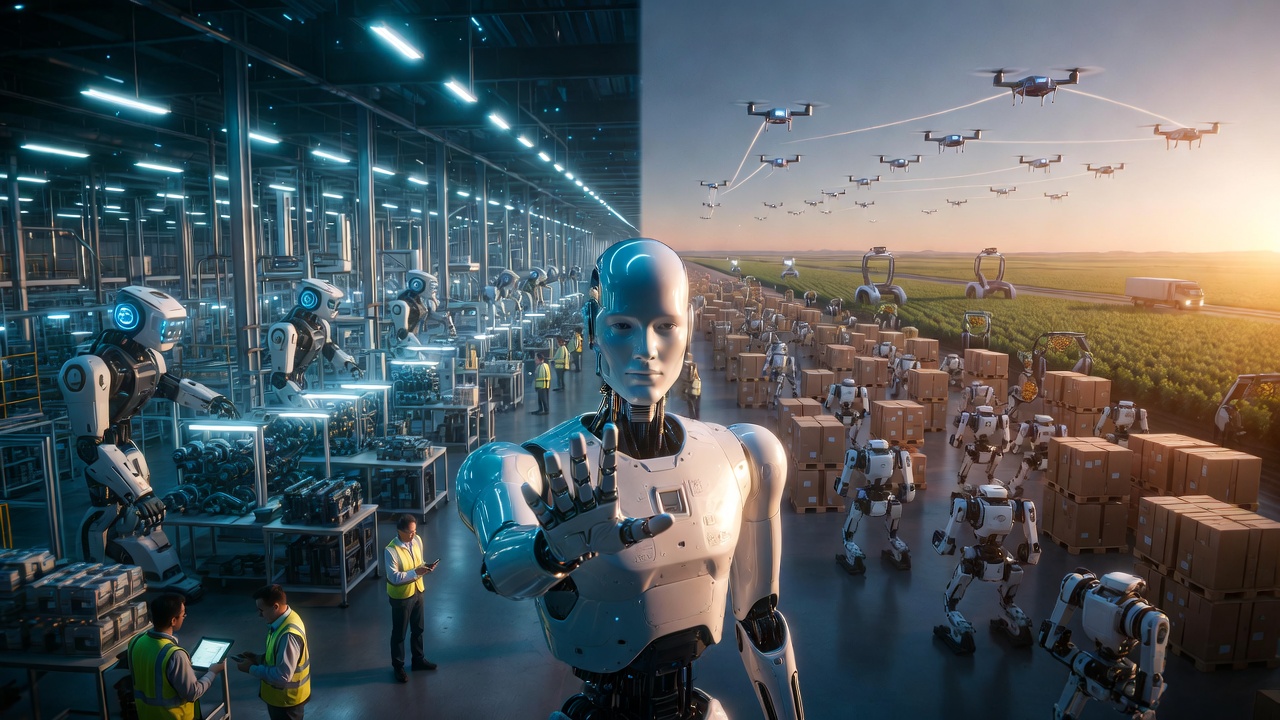
Bold predictions for the age of physical AI — when machines stop living in your screen and start living in your world
There is a moment in the history of every transformative technology when the thing stops being a demonstration and starts being a fact. When it moves from “look what’s possible” to “this is just how things are now.” We had that moment with smartphones in roughly 2010. We had it with the internet in roughly 1998. We are, right now, in the last few months before we have it with robotics.
I don’t say that lightly. The robotics industry has been promising that moment for thirty years. The history of humanoid robots in particular is a graveyard of overpromised demonstrations and underdelivered products — machines that could walk across a stage at a press conference and then spent the next three years in a lab being quietly improved while the hype faded. Boston Dynamics has been showing us incredible robot videos for over a decade. Honda’s ASIMO waved at the world for twenty years. The demos were real. The deployment was not.
But something has changed, and if you’re still applying the old skepticism to the new reality, you’re going to be caught flat-footed by what’s coming. The change is not in the hardware, though the hardware has improved substantially. The change is in the intelligence. The large language models and vision systems that have transformed software AI in the past three years have been plugged into physical machines, and the result is a qualitative leap in robot capability that the previous decades of incremental hardware improvement never achieved.
A robot that can see, reason about what it sees, understand natural language instructions, adapt to novel situations in real time, and learn from its mistakes is a fundamentally different class of machine from a robot that can perform a pre-programmed sequence of movements with precision. The former is a tool. The latter is something closer to a worker.
We now have the latter. And the predictions I’m about to make are built on that reality, not on optimistic extrapolation from the former.
Prediction One: The Factory Floor Will Be Unrecognizable Within Five Years
Let’s start with the domain where robotics deployment is already furthest advanced, because the pace of change here is already outrunning most people’s mental models.
Manufacturing automation is not new. Industrial robots have been welding car frames, placing circuit board components, and packaging consumer goods for decades. But the robots doing this work have been, almost exclusively, fixed-purpose machines — programmed to do one thing, in one place, in a controlled environment where everything is exactly where the robot expects it to be. Move a component bin two inches from its expected position and the robot either jams, misses, or crashes. The brittleness of these systems is the reason they’ve required enormous amounts of human infrastructure around them — humans to load the bins, humans to handle the exceptions, humans to deal with everything that doesn’t conform to the robot’s narrow expectations.
The new generation of AI-enabled robotic systems is not brittle in this way. They can handle variation. They can identify a component in an unexpected orientation and adjust their grasp accordingly. They can recognize that something has gone wrong and stop or ask for help rather than creating a cascading failure. They can be retrained for a new task in hours rather than weeks. They can work alongside humans without elaborate safety caging because they can perceive and respond to human presence dynamically.
The economic implication of this shift is enormous and underappreciated. The old industrial robots made sense only for very high-volume, very standardized production where the cost of programming and the cost of the surrounding human infrastructure could be amortized over millions of identical operations. The new systems can be deployed cost-effectively at much smaller scale, in much more varied environments, for much more diverse tasks.
This means the automation wave reaches industries and factory scales that were previously immune to it. The mid-sized manufacturer producing customized components. The food processing facility handling products that vary in size, shape, and consistency. The warehouse managing thousands of different SKUs. The electronics assembly operation doing short production runs of high-mix, low-volume products. These operations have been labor-intensive because they needed human flexibility. They can now have robotic flexibility.
Within five years, I predict the factory floor in every major industrial sector will have more robots than it does today by an order of magnitude, and the robots will be doing work that today requires human judgment — not just human physical labor. The manufacturing workers who remain will be the ones managing, maintaining, programming, and collaborating with the robots rather than performing the physical operations the robots have taken over.
This is going to be economically disruptive in ways that the “automation has always created more jobs” reassurance does not adequately address. The manufacturing jobs being automated now are not the repetitive, dangerous, physically brutal jobs of the early automation era — those are largely already gone. The jobs being automated now are the skilled, experienced, moderately well-paid jobs that required years of practice to do well. The human expertise that made these workers valuable is being encoded into AI systems and deployed at scale. The transition is real and the timeline is short.
Prediction Two: Humanoid Robots Will Enter Real Workplaces — Not Homes — By 2027
The humanoid robot has been the aspirational symbol of robotics for as long as robotics has existed. The dream of a machine shaped like a person, capable of doing anything a person can do, operating in the environments humans built for themselves — it’s been the promise and the punchline of the field for fifty years.
I am not predicting the humanoid robot companion in your living room. That’s still years away and may never be the right form factor for the home environment anyway. What I am predicting is more specific and more imminent: humanoid robots doing structured physical work in commercial and industrial settings within the next two years.
The distinction matters. The home environment is unpredictable, emotionally complex, full of fragile objects and irrational humans, and requires a level of social and physical sophistication that current robots don’t have. The commercial warehouse, the manufacturing facility, the retail stockroom, the hospital materials handling operation — these are structured, predictable enough to be manageable, and critically, the economics justify the investment.
The companies pursuing this with genuine seriousness are no longer just startups burning venture capital on impressive demos. They include Tesla, whose Optimus robot has moved from concept to working prototype to early production with a speed that suggests genuine corporate commitment rather than a publicity exercise. They include Figure AI, Agility Robotics, Boston Dynamics, and a cohort of well-funded competitors who between them represent billions of dollars of investment targeted at the same near-term commercial opportunity.
That opportunity is the labor-constrained warehouse and logistics operation. Amazon alone operates hundreds of fulfillment centers that require thousands of workers doing physically demanding, repetitive tasks in structured environments. The turnover in these facilities is enormous. The injury rates are elevated. The labor cost is significant and rising. A humanoid robot that can do the unloading, the carrying, the placing, and the sorting in these environments at a cost below human labor — and that cost crossover point is closer than most analysts are acknowledging — transforms the economics of e-commerce fulfillment.
The timeline I’m putting on this — humanoid robots in real commercial workplaces by 2027 — is not optimistic. It’s based on the production commitments that companies have already made, the pilot deployments that are already underway, and the rate at which the capability gaps are closing. The skepticism that has been appropriate to apply to previous generations of humanoid robot demos is not appropriate to apply to the current generation of systems, because the underlying AI has changed the capability curve fundamentally.
What I’m less certain about — and will not pretend to predict with confidence — is the pace of scaling from early deployment to widespread deployment. Getting robots working in one warehouse is a very different engineering and operational challenge from getting them working reliably in hundreds. The first robots in commercial settings will require more human supervision, more maintenance intervention, and more careful task selection than the mature deployed systems will. The scaling curve could be steep or it could plateau at limited deployment for several years before the reliability and cost thresholds for mass deployment are crossed.
But the direction is not in question. Humanoid robots are coming to commercial workplaces. The question is how fast.
Prediction Three: The Surgical Suite Will Be Transformed in Ways Medicine Hasn’t Processed Yet
Here is a prediction in a domain that doesn’t get enough attention in robotics coverage, possibly because it requires understanding both the technology and the medical context simultaneously.
Robotic surgery is not new — the da Vinci surgical system has been in clinical use for over two decades, and robotic assistance in surgery has expanded steadily. But what exists today is robotic assistance — a tool that amplifies surgeon precision, reduces tremor, enables minimally invasive access to difficult anatomical locations, and allows surgeons to operate with greater control than their unaided hands would permit. The robot does what the surgeon tells it. The surgeon’s judgment, skill, and real-time decision-making remain the core of the operation.
What’s coming is different in a way that will be genuinely controversial in medicine, and appropriately so.
AI systems trained on enormous datasets of surgical procedures — video recordings, outcome data, imaging, physiological monitoring — are developing the ability to assist not just with physical execution but with surgical judgment. Systems that can flag anatomical structures that should be avoided. Systems that can suggest the next step in a procedure based on the current state. Systems that can identify in real time when a tissue plane is being developed incorrectly and alert the surgeon before a complication occurs. Systems that can, in limited and well-defined procedural contexts, perform sub-tasks autonomously while the surgeon supervises.
The leap from “robot that does what the surgeon tells it” to “robot that advises the surgeon in real time” to “robot that performs defined sub-tasks autonomously” is a leap that medicine is not fully prepared to navigate — ethically, regulatorily, or culturally. Surgery is built on a culture of individual physician responsibility. The surgeon is accountable for the outcome. When an AI system is advising or assisting in ways that influence outcomes, the accountability question becomes genuinely complicated.
But the pressure toward these systems is going to be enormous. The evidence that AI-assisted surgical planning improves outcomes is accumulating. The evidence that robotic precision in certain procedures reduces complications is solid. The global shortage of surgical expertise — the fact that the world has far fewer trained surgeons than the world’s population needs, with the gap most acute in low- and middle-income countries — creates a compelling argument for technologies that can extend surgical capability beyond the constraints of individual human training.
Within ten years, I predict that robotic surgery systems with meaningful AI-guided autonomy in defined procedural contexts will be in clinical use in leading hospitals. Within fifteen, they will be standard of care for certain procedure types. The resistance from the surgical community will be real — it will be argued on patient safety grounds, on liability grounds, on professional identity grounds. Some of those arguments will be valid and will appropriately shape how these systems are deployed. But the trajectory is set.
Prediction Four: Agricultural Robots Will Quietly Solve a Crisis Nobody Is Talking About
Here is the prediction that I think is most underappreciated in mainstream technology coverage, and which I believe will matter more to more people’s daily lives than the humanoid robot in the warehouse.
Global agriculture faces a labor crisis that is not receiving adequate attention. The physical work of farming — planting, tending, harvesting — is extraordinarily labor-intensive in its high-value crop segments. The farmworkers who do this work in wealthy countries are disproportionately migrant workers, often in precarious legal status, doing physically brutal work in difficult conditions for wages that have not kept pace with the cost of living. In many developing countries, agricultural labor represents a large fraction of the workforce doing backbreaking work with low productivity.
The labor supply for agricultural work is declining. In wealthy countries, domestic workers have alternatives. Immigration politics have constrained the migrant labor flows that high-value agriculture depends on. In developing countries, urbanization is pulling agricultural workers toward cities. The result is a gathering crisis in the food supply chain that is being managed through a combination of higher wages, mechanization where possible, and in some regions actual crop losses because there are not enough hands to harvest.
Agricultural robotics is developing at a pace that is not receiving the mainstream attention it deserves because it doesn’t look as dramatic as a humanoid robot. But the systems being deployed and developed for specialized agricultural tasks — robotic strawberry pickers, automated apple harvesters, AI-guided crop monitoring drones, weeding robots that can distinguish crop from weed with greater accuracy than human hand-weeders — are solving a real and urgent problem.
The technical challenges of agricultural robotics are genuinely hard. Natural environments are more variable and less structured than factories. Crops grow in three dimensions with enormous variety within a single field. The manipulation tasks — picking a ripe strawberry without bruising it, identifying the correct cutting point on a cluster of grapes — require fine motor skills and visual judgment that are at the frontier of current robotics capability.
But the frontier is being pushed, and the economic incentive is enormous. A robot that can reliably pick strawberries is worth more per hour than any human picker and can work longer, in worse conditions, with no immigration paperwork. The companies solving these problems are not the glamorous AI startups that get covered in TechCrunch. They are specialized agricultural technology companies working in relative obscurity on problems that matter enormously.
Within five years, I predict that robotic harvesting will be commercially deployed at scale for at least three or four high-value crop categories beyond the narrow set where it exists today. Within ten, robotic and semi-autonomous systems will be handling the majority of harvesting work in commercial agriculture in wealthy countries. The impact on food costs, food security, and agricultural labor markets will be profound.
Prediction Five: Autonomous Vehicles Will Finally Arrive — Just Not the Way You Expected
Let me tell you the autonomous vehicle prediction that I think is actually right, as opposed to the one that’s been wrong for a decade.
The autonomous vehicle story of the 2010s went like this: within five years, self-driving cars will be on every road. Level 5 autonomy — fully self-driving in all conditions without human supervision — is right around the corner. Waymo, Tesla, Cruise, Uber, and a dozen others are racing to get there. The taxi driver, the truck driver, the commuter — all their driving will be done by AI.
That prediction was wrong, and wrong in a way that contained a lesson. The “last mile” of autonomous driving — the edge cases, the unusual situations, the scenarios not represented in the training data, the weather conditions and road conditions and human behaviors that don’t conform to the training distribution — proved to be much harder than the 95% case suggested. Getting from 95% reliable to 99.9% reliable in an environment where a failure can kill someone turned out to be a different order of engineering challenge from getting from 0% to 95%.
The lesson: the difficulty of a technical problem does not scale linearly with the percentage of it you’ve solved. The last five percent of autonomous driving is not five percent of the work. It is most of the work.
But here’s what the pessimistic reaction to this lesson gets wrong: it concludes that autonomous vehicles won’t arrive, when the correct conclusion is that they’ll arrive differently. Not everywhere at once, in all conditions, for all use cases. But in specific, well-defined, controlled domains where the edge cases can be managed.
Robotaxis in geofenced urban areas with high-quality mapping — already a reality in San Francisco, Phoenix, and several other cities — will expand to more cities, more hours of operation, and more weather conditions over the next five years. The economics of driverless taxi services, once the capital cost of the vehicles is amortized, are compelling. The reliability in defined operating domains is already at commercial deployment levels.
Long-haul highway trucking — where the road environment is more predictable than urban streets, the routes are limited and mappable, and the economic case is enormous — will see meaningful autonomous deployment within three years. The model that’s emerging is not fully driverless but “driverless on the highway, human-operated in terminals and urban environments” — which captures most of the economic value while managing the hardest technical challenges.
Port and yard operations — moving containers within a defined, controlled facility — are already substantially autonomous at leading facilities and will be essentially fully autonomous within three years. Mining haul trucks in controlled pit environments are already operating autonomously at scale.
The prediction I’m making is not “autonomous vehicles everywhere by 2030.” The prediction is “autonomous vehicles in specific high-value, well-defined domains by 2028, with gradual expansion of those domains over the following decade.” That’s less exciting as a headline. It’s the thing that’s actually going to happen.
Prediction Six: The Home Robot Will Arrive Last — But It Will Arrive
I told you at the beginning that I’m not predicting the home robot imminently. Let me explain why, and then tell you when I actually think it arrives.
The home is the hardest environment for robotics. It is unpredictable in ways that factories and warehouses and even roads are not. Every home is different. Every family has different objects, different layouts, different routines, different tolerances for a robot moving their things. Children are unpredictable. Pets are unpredictable. The surfaces are varied — carpet, hardwood, tile, stairs. The tasks are varied — cooking, cleaning, laundry, tidying, carrying — and each requires different physical capabilities and different kinds of judgment.
More importantly, the home is emotionally loaded in ways that commercial environments are not. A robot in a warehouse that makes a mistake costs money. A robot in a home that breaks a cherished object, scares a child, or behaves in a socially inappropriate way creates a different category of harm. The tolerance for error is much lower. The range of situations requiring appropriate social and emotional response is much wider. The liability questions are genuinely difficult.
This is why the smart money in home robotics right now is not on general-purpose humanoid home robots. It’s on single-function devices that do one thing reliably well. The robot vacuum (already mass market). The robot lawn mower (emerging). The automated pet feeder, the smart thermostat, the robotic window cleaner — a collection of narrow-purpose automated devices that together handle a growing slice of household maintenance.
The general-purpose home robot — the one that can do the dishes, fold the laundry, tidy the living room, and respond to “can you get me a glass of water” — is probably a 2030 to 2035 story for early adopters and a 2035 to 2045 story for mass market. The hardware and AI capability will be there sooner. The price, the reliability, the social calibration, and the product design required to make a robot feel welcome in a home rather than intrusive and anxiety-inducing — those will take longer.
When the home robot does arrive, I predict the form factor will surprise people. It will not look like a humanoid. It will look like a piece of furniture — designed to be unobtrusive, to blend into domestic environments, to not feel like a machine in the way that current robot aesthetics suggest. The companies that crack the home robot market will be the ones that solve the design and social integration problem as thoroughly as they solve the technical problem. The best robot that feels like a robot in your home will lose to a merely good robot that feels like it belongs there.
Prediction Seven: A New Geopolitical Race Is Already Underway — And Most People Don’t Know It
Here is the prediction that I think has the most profound long-term implications and the least mainstream awareness.
The race to lead in physical AI and robotics is not just a business competition. It is a geopolitical competition with implications for manufacturing capacity, military capability, economic productivity, and national power that rival — and in some dimensions exceed — the competition in software AI.
China understood this earlier and more clearly than most Western governments. Chinese robotics manufacturing is already dominant in many categories of industrial robot. Chinese companies are advancing rapidly in humanoid robotics, with significant government investment and an explicit national strategy that identifies robotics leadership as a strategic priority. The combination of China’s manufacturing scale, its engineering talent, its willingness to deploy government capital, and its domestic market for testing and iterating robotics systems represents a formidable competitive position.
The United States has the edge in AI software — the large language models and vision systems that are the brains of the new generation of AI-enabled robots were largely developed by American companies. But the hardware — the motors, the sensors, the actuators, the structural components — that goes into robots is increasingly manufactured in China, by Chinese supply chains, with Chinese component suppliers. The dependency that exists in semiconductors — American design, Asian manufacturing — is being replicated in robotics, and the strategic implications are similar.
Europe has strong robotics research institutions and several leading robotics companies, but lacks the combination of AI software leadership, manufacturing scale, and government-directed investment that characterizes the U.S.-China competition.
The military implications of robotics are real and are being actively developed, and I will not pretend otherwise. Autonomous military systems — drones, ground vehicles, logistics robots — are already deployed and are advancing rapidly. The ethical and legal questions around autonomous weapons are serious and have not been adequately addressed by international law or norms. The countries that lead in robotics will have military advantages that will shape the balance of power in ways that are hard to predict and harder to constrain once they are established.
What this means practically is that robotics is going to receive levels of government attention, investment, and strategic direction over the next decade that will accelerate the technology beyond what private market incentives alone would produce. The strategic competition will fund research, subsidize deployment, and create protected domestic markets in ways that will make the pace of advance faster than the technology’s commercial economics alone would justify.
Prediction Eight: The Philosophical Question Nobody Wants to Answer
I want to close with the prediction that is the most uncomfortable, because it’s not really a prediction about technology. It’s a prediction about us.
As robots become more capable — as they move from tools to collaborators, from machines to something that looks increasingly like workers, as they develop the ability to learn from experience and adapt to novel situations and respond to human social cues — we are going to face questions about how we think about them that our existing frameworks are not equipped to handle.
These are not questions about robot rights or robot consciousness in the science fiction sense. They are more mundane and more immediate. When a robot learns a task through something that looks like practice and makes something that looks like mistakes and improves through something that looks like experience — is the output of that process owned by the manufacturer, or by the operator, or by something else? When a robot works alongside humans for years in the same facility, developing what appears to be task-specific knowledge and operational preferences — what are the ethical considerations around replacing it abruptly, not for the robot’s sake but for the sake of the humans who have developed working relationships with it?
When a child grows up with a robot in the home that responds to her needs, learns her preferences, and is a consistent presence in her daily life from infancy — what is the psychological and developmental significance of that relationship, and what are the obligations of the manufacturer who can update, alter, or discontinue the robot’s operation at will?
I am not arguing that robots have feelings or that they deserve moral consideration equivalent to humans or animals. I am arguing that our increasing entanglement with sophisticated machines that behave in socially meaningful ways is going to create situations that our existing ethical, legal, and psychological frameworks are not ready for — and that thinking about them now, before the entanglement is deep, is more useful than thinking about them after.
The history of technology is full of cases where we deployed a powerful new thing without thinking carefully about its social and ethical implications, and spent decades trying to manage the consequences. We are in the early stages of deploying physical AI into the most intimate domains of human life — our homes, our healthcare, our children’s education, our workplaces. The technical predictions I’ve made in this article are, I believe, going to prove roughly correct. The social and ethical frameworks we’ll need to navigate what those predictions produce — those are still largely unwritten.
That, more than any specific robot capability or deployment timeline, is the real challenge of the age of physical AI.
The Bottom Line
The robots are not coming. They are here, and they are getting better faster than the public conversation has caught up to.
The pace of the next ten years will make the last ten look like a rehearsal. The factory floor will be transformed. The warehouse will be transformed. The surgical suite, the farm, the logistics network, the road — all transformed, on timelines that are measured in years, not decades.
The people who will navigate this well are the ones who are looking at these changes clearly, without the old skepticism that was appropriate for the old robotics and is not appropriate for the new, and without the naive enthusiasm that ignores the very real disruption these changes will cause to very real people’s lives and livelihoods.
The robots are getting smarter. The question is whether we are.
Disagree with a prediction? Working in robotics and think I’ve got something wrong? The comment section exists for exactly this conversation. The best forecasting is a contact sport.